Stephen Rayment
Founder, CEO & Group Managing Director
Founder, CEO & Group Managing Director
How a multi-disciplinary practice keeps its expert witnesses independent, and why the answer has to be structural
There is a question that every expert working inside a multi-disciplinary practice should expect in cross-examination, and it is not really about methodology.
Your instructing solicitor works for the same group as you. You share a brand, a client relationship and, ultimately, a set of accounts. Explain to the tribunal why your opinion is your own.
It is a fair question. An expert who cannot answer it crisply, on the first attempt, has a problem that no amount of technical rigour will repair.
The courts have moved decisively on expert independence in recent years, and they have not confined themselves to criticising individuals.
In Andrews v Kronospan [2022] EWHC 479 (QB), the claimants lost permission to rely on their expert altogether after their solicitors commented on drafts of the joint statement in terms that went well beyond formatting. Roughly £225,000 of expert fees and more than three years of work were written off. In Dana UK Axle v Freudenberg [2021] EWHC 1413 (TCC), expert evidence was excluded shortly before trial where the substance of instructions had not been set out and there had been undisclosed contact with the party’s personnel.
The pattern in both is instructive. The court was not much interested in whether the opinion had in fact been changed. It was interested in whether the process was capable of influencing it, and whether the expert could still be trusted.
For multi-disciplinary practices, Secretariat Consulting Pte Ltd v A Company [2021] EWCA Civ 6 sharpened the point further. Conflict obligations were held to run across the corporate group, not to stop at the boundary of the individual entity or the individual expert. Structure alone is not a defence. It is where the analysis begins, not where it ends.
THE TEST THE COURT APPLIES
Whether the process was capable of influencing the opinion, and whether the expert could still be trusted.
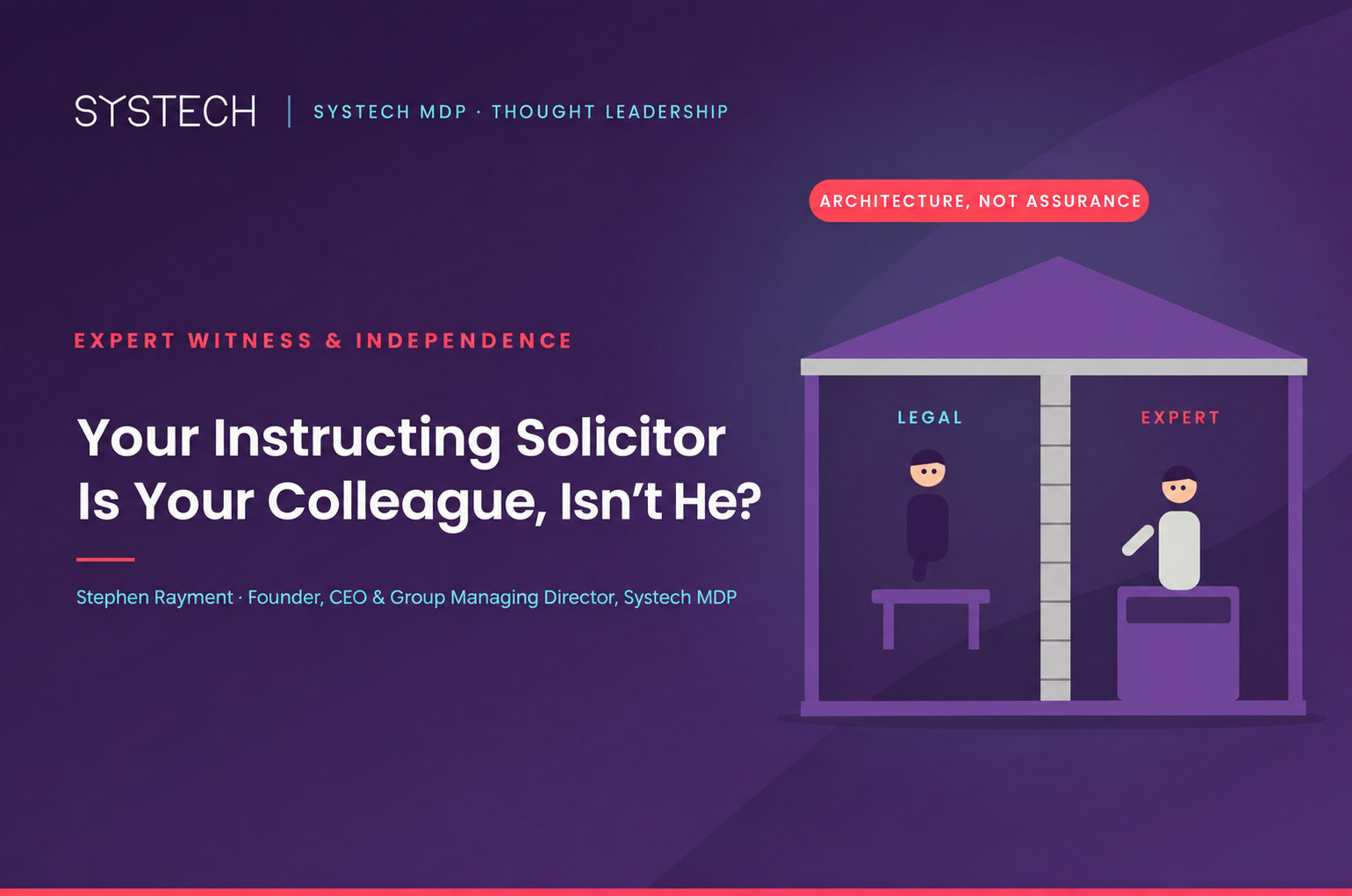
Saying “our experts are independent” is worth nothing in a witness box. What carries weight is being able to show the tribunal a set of arrangements that were put in place before anyone knew which way the evidence would fall. In our view that means at least the following.
Separate appointment, separate terms. The expert is appointed under their own engagement, on their own terms, with their own scope and their own fee basis. A single point of contact for the client is a commercial convenience; it must not become a single point of instruction for the evidence.
Disclosure at the outset, in writing. The relationship between the legal team and the expert’s firm is disclosed to the other side and to the tribunal at the point of appointment, not extracted in cross-examination two years later. A relationship that has been declared and accepted is a fact. A relationship that emerges late is a weapon.
Conflict checks across the group, not the entity. Secretariat is the authority; the practical answer is a single conflicts register covering every business in the group, re-run whenever a party, witness or expert is added to a matter.
Unconditional fees, with no shared outcome interest. Time-based or fixed fees for the expert, with nothing contingent on the content of the evidence or the result. Where any part of the wider group’s remuneration is outcome-linked, the expert’s engagement has to be visibly insulated from it, and that insulation has to be capable of explanation.
Comment on drafts limited by category. Draft reports are privileged, but privilege is protection from disclosure, not permission to influence. Comment from those instructing should be confined to completeness, clarity, factual accuracy and Part 35 compliance. It should not reach the substance of the opinion or the strength with which it is put.
A closed joint statement window. From the start of experts’ discussions until the joint statement is signed, no contact with those instructing on its content. The TCC Guide permits intervention only where a draft appears likely to mislead the court, and any such intervention should be made openly. This is where Kronospan was lost, and it is the single discipline most worth being rigid about.
A route out. The expert retains the ability to write to the tribunal for directions under CPR 35.14, to escalate internally, and, if it comes to it, to resign the instruction. An expert who cannot resign is not independent, whoever employs them.
There is a distinction that multi-disciplinary practices have a particular duty to keep clean: the expert adviser and the expert witness are different roles.
Advising a client on the strengths and weaknesses of its position, pre-action and in confidence, is legitimate, valuable and outside the CPR Part 35 regime. Giving independent opinion evidence to a tribunal is something else entirely. The two roles can sit in the same organisation. They should rarely sit in the same person on the same dispute, and where an individual moves from one to the other, the transition must be identified, documented and disclosed.
Getting this wrong is not a technicality. It is the difference between an expert whose evidence is preferred and an expert whose evidence is excluded.
Before accepting any instruction where the legal team sits within the group, the question is not “can we manage this?” It is: if every communication between the expert and those instructing were read out in open court, would the arrangement still look right?
Where the honest answer is no, the instruction should go to an independent firm. That will occasionally cost a fee. It costs considerably less than a revoked permission.
THE STANDARD
If every communication between the expert and those instructing were read out in open court, would the arrangement still look right?
What safeguards does your organisation apply where legal and expert services sit under one roof? I would be interested in how others are handling disclosure in particular.
Systech International is an independent, privately owned consultancy providing claims, dispute resolution, commercial management, legal and expert witness services. This article is general commentary on expert independence in multi-disciplinary practices, not legal advice; requirements differ by jurisdiction and any instruction turns on its own facts.